TRAP → NEUTER → RETURN
swipe to see more photos
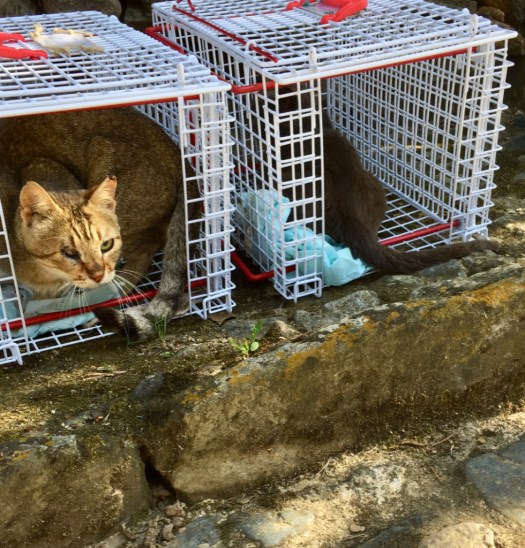
TNR is the internationally recognised method of caring for cats in feral colonies, who without regular feeding and medical attention would otherwise face very short and often painful lives.
The cats are trapped, neutered, then returned to the colony as quickly as possible. Neutering ensures that the colony numbers do not grow exponentially, exceeding the sustainable amount of food available to them locally. It protects the females from terminal illnesses such as mammary cancer, infection in the uterus and diseases like Feline Leukaemia and Feline Immunodeficiency Virus which are both spread by mating. Aggression among males is drastically reduced. And the kittens live a lot longer, as they can be fostered and socialised enough to be adopted into a human home. The adults would never settle into this kind of domesticity, so returning them to the same familiar colony is the best and kindest solution.
To explain more about this work and the skills required to trap and rehome feral cats so they don’t suffer any stress, Barbara Anderson (one of our SCR Trustees) has started an ongoing blog:
– click on the shortcut links (newest first), or simply read all the chapters in chronological order –
- 2025 overview
- August 2025
- later in July 2025
- July 2025
- June 2025
- April 2025
- later in March 2025
- March 2025
- November 2024
- Pauline Dean’s experience of trapping in rural Spain
November 2024
I have been involved with TNR at Shetland Cat Rescue since August 2024. In that short time I have learnt and achieved so much. Mostly I have been out working on my own, sometimes with another volunteer. When I was first shown how the traps work, and all the other things I needed to be aware of, it all felt very daunting. The fact that I would be dealing with living, breathing and fearful animals seemed such a big responsibility and a bit scary.
But perhaps, before I go any further, I should begin by emphasising that none of this would be possible without the co-operation of all the other people involved. Those who are feeding the feral cat colonies and alert us of their existence. The vets, who are ready on standby when we go out to trap. And of course all the many volunteer fosterers at Shetland Cat Rescue, who take in and socialise the kittens. It really is the work of many.
There are more than just a few feral colonies in Shetland, and not all of them can be considered ‘trappable,’ as we can only hope to be successful when the cats are already used to a human presence from being fed regularly. This hadn’t occurred to me before and was quite a shock to learn. Nor can we just set out a trap and leave it. We are dealing with wild animals so have to stay with the trap so when a cat is caught we can act immediately. This is an extremely stressful experience for them, and if they are confined for a prolonged period of time they might injure themselves.
There are many feral cats who are struggling to survive on their own, having litter after litter of kittens, handicapped by weather, disease and injury. Most of whom will not survive into adulthood. It’s a very sobering thought.
The first step in trapping, after we have been asked to intervene, is to make an appointment with the vet. Then my next job is to inform the person who is feeding the feral cat or cats, what day I’ll be there, so they don’t feed them. A hungry cat is far more likely to go into a trap when there is food inside. On the morning of trapping I need to be up as soon as it is light to get to the site and set up before the cats arrive.
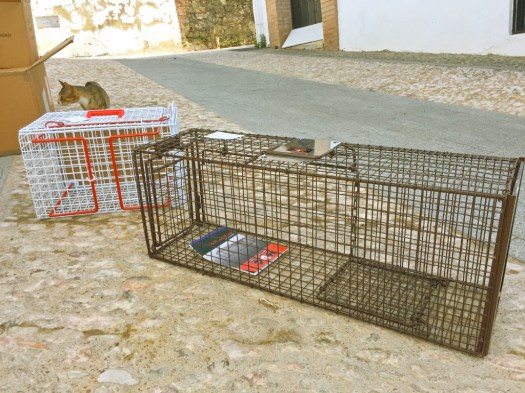
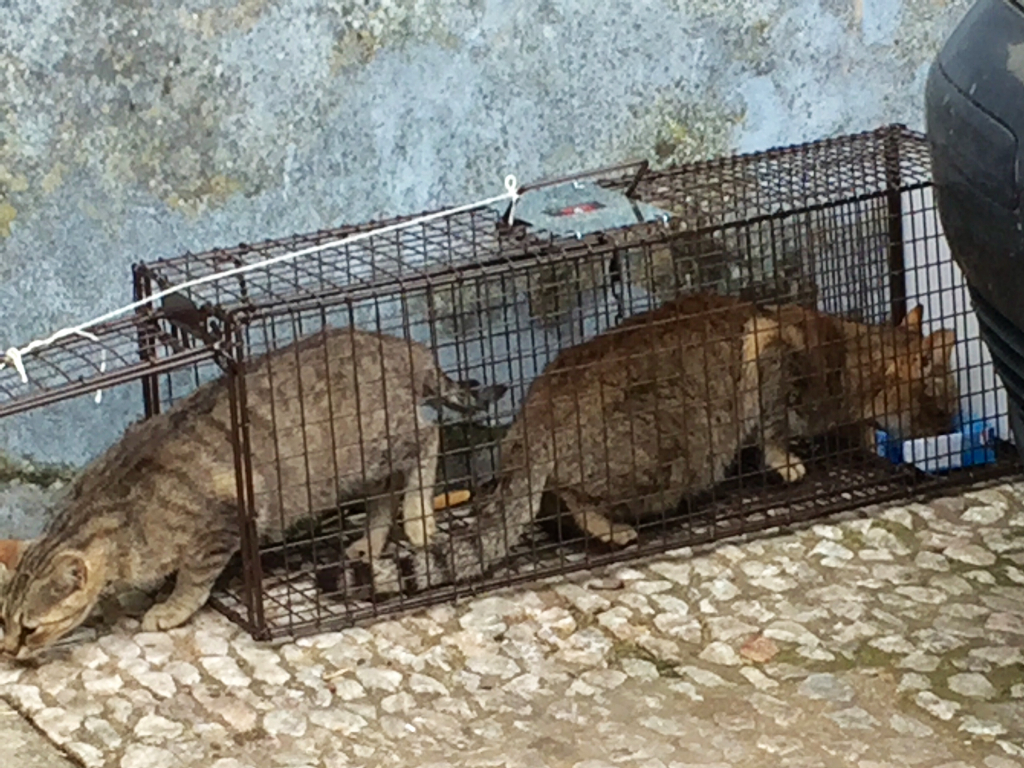
We tend to use an automatic trap for adult cats. This is made from strong wire mesh, so as to be as inconspicuous as possible, and the shape is long and narrow. Food is laid inside, far enough in so that they have to walk across the trigger for the trap first. The first time I used one of these was with an experienced colleague, to show me how. We had gone out with the hope of trapping two cats and had booked that number with the vet. Amazingly, everything went exactly as planned and we caught two females, a real bonus.
When a cat is trapped it has to be transported to the vet’s as soon as possible, to reduce the amount of stress for the cat and so the vet has sufficient time to operate and for the cat to recover afterwards, sufficient for it to be released back into the colony.
A common practice when neutering a feral cat is for the vet to make a small cut on the left ear tip. This is done during the operation and the wound is cauterised. The reason for this is to make it easier to identify later it as an already neutered cat. Particularly in a colony with many cats. The one I am currently working with, in South Mainland, has at least 17.
There’s no rule of thumb for how long it takes to trap, it can be a few minutes or several hours. Often a cat walks in, eats the food and manages to walk straight out, without tripping the mechanism. This is because the door doesn’t always shut as it should. Recently this happened to me with a dilute tortie (blue cream in colour), which was a real disappointment as she was female (of course). The mechanism is straightforward but very rudimentary so a tad finicky. There’s a horizontal and a vertical pole, and one has to rest against the other. If I set it too high it might not shut, and too low it might shut too early. If the latter happens, the cat puts one paw inside and the door swings down, it scares them off and they may become trap-shy, never trusting one again even if they are hungry. I have also caught cats then had to let them go, as they turned out to have been ear tipped. To prevent this I now carry a pair of binoculars and with these can usually see who’s approaching the trap. I have also trapped a cat and it wasn’t until we were at the vets that we discovered they had already been neutered. That’s very frustrating. My last time this happened. I caught two cats separately and had to let them go for this reason (both were ear tipped). I have also been out many times and not caught a single cat. That’s how it is with trapping.
I have however been extremely fortunate in trapping two feral kittens. I did this with a trap which is triggered manually. A long length of string operates the door mechanism and this is long enough so the operator can be invisible to the kitten. We use these instead of the automatic type because the door on the automatic ones could cause an injury to the kitten if the door fell on top of them. It took me two days of trapping to get them both, then they were fostered together and have now been adopted by the same person. This is one of the things that make the job so rewarding.
With feral kittens it is not so easy to know their age. These two had to be more than 2 months old, because their eyes were no longer blue. Now that winter is fast approaching and we have already had cold nights and snow, I am so relieved that they will no longer have to endure that or hunger. The mum is still out there though and maybe already nursing a new litter. It doesn’t bear thinking about. Life is harsh enough for them as it is and the winters especially can be brutal.
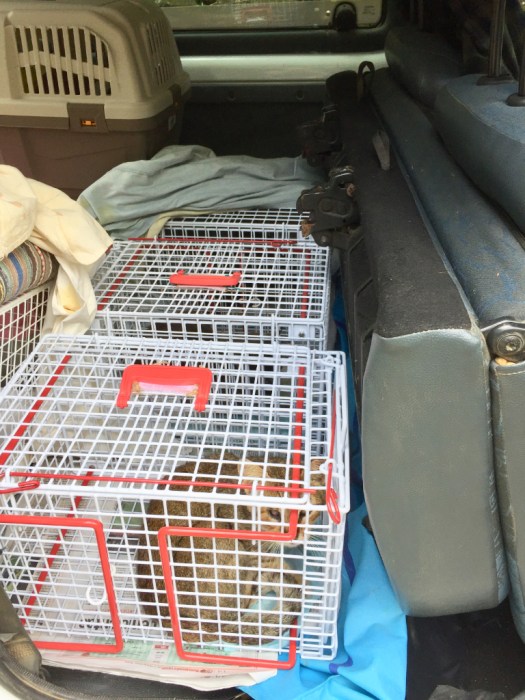
There is a lot of waiting around involved in trapping. Often when I arrive at the site I may already see a few cats about, and of course then they all vanish, so it’s back to the car and wait. This could be 10 minutes or a lot longer, before a cat will reappear, they are extremely wary. Once a cat is in the trap though, I have to work quickly. First transferring it from the trap to a special carrier. The only way to do this is cover the trap with a towel or blanket first. This is to help calm the cat, as by now they are usually frantic. Then I line the carrier up with the trap, usually using bungee clips to ensure that both cages are secure, it would not do for the cat to escape at this point. Then I move the cover from the trap to the carrier. This encourages the cat to move with it, seeking the safety of a dark place. Finally, put food out for the rest of the colony, as they have not been fed that morning. Then it’s off to the vet. Where I fill out all the paperwork and sign a consent form and they take over. Once the cat is awake, after the operation, I return and take them back to the colony. The vet has given them painkillers which last 72 hours, so by the time those wear off they will be healing perfectly.
I am lucky enough to have a lot of free time, which helps being able to do this kind of work. I hope also to carry on doing TNR for as long as it is needed. So far we have been able to neuter 4 females and 2 males, plus caught and re-homed 2 kittens. That’s pretty good going in such a short time.
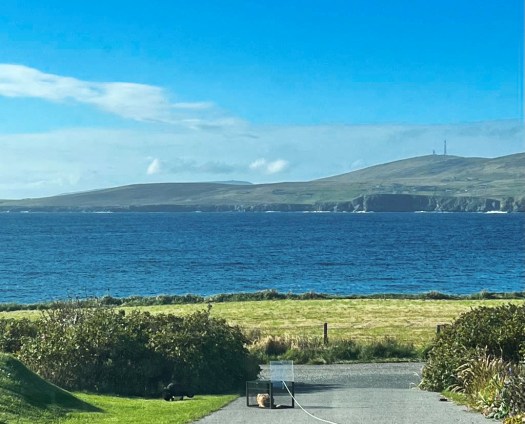
This is when I was trying to trap one of the kittens. You can see the string used to spring the trap shut. There is an adult inside, who was eating all the food. I trapped this one too and then released it and set the trap again.

Some of the cats at the South Mainland colony.
March 2025
In February 2025 I began trapping again.
It’s much more tricky to trap a feral cat in winter, especially in Shetland. As I mentioned before, the first step involved in trapping a known feral cat (that is used to being fed) is making an appointment with the vet. Usually I make the appointment for about 9am. They are very good about giving me a lot of leeway. Usually I have up to about 10.30am to trap a cat and bring it to the surgery. Of course, with daylight being later and later in winter here, it doesn’t give me much time to trap. It’s difficult to trap a cat when you can’t see clearly what is going on because it’s still dark.
The weather doesn’t help either. Driving winds and rain make it that bit harder. The cats are less likely to appear. When we had snow on the ground I cancelled my weekly appointments.
My luck changed though on February the 18th. Weather-wise, it was a bit windy but dry. I arrived and set up the trap. I think I got there about 8.30am. Over the next two hours three cats came to inspect the trap. In the trap, wet food is laid along the centre in little piles. Small piles at the entrance and bigger piles at the back. This is to try and draw them in.
Most of the feral cats in this colony seem to have learnt how to poke their head in just enough to be able to snatch a mouthful or two. They’ve become very wary of the trap.
At one point a car came by when one of them was doing this. Thankfully it didn’t scare him off, but he didn’t go further into the trap.
10.30am is approaching and I’m feeling discouraged and am beginning to think about packing up. My car is parked a moderate distance from the trap, facing it.
All of a sudden, a small ginger cat appears from under my car, and slowly makes his way towards the trap. I don’t know how long he had been sheltering under the car. I’d never seen this cat before. From his gait I could see that he was in some way disabled. He staggers with his back paws.
So, he slowly made his way over to the trap. My heart was in my mouth. He sniffed around very cautiously. He put his head in the trap, eating the food. He kept moving forward to eat more, still very hesitant.
And then it happened. He moved far enough in that he stepped on the lever which triggered the door to come down. He was trapped!
I got out of the car as quickly as I could and grabbed the transport cage, a large towel, my thick gloves and 2 bungee clips.
Transferring him to the transport cage was quite straightforward. He didn’t appear to be too stressed.
And so he was taken to the vet and was neutered.
I later spoke to the person who feeds this colony. She said that there is a 4 year old ginger cat who was run over three years ago. We both think that it must be him. Already these cats have such a hard life. This boy is obviously a fighter.
We think that there are still about 4-5 cats in this colony that need to be spayed or neutered.
Now that it is getting lighter earlier, I plan to be at the site on a trapping day much, much earlier. The more time I have, the more likely it is that I can trap one. The people who feed these cats are also putting the food in the trap, as most of them are so wary of it.
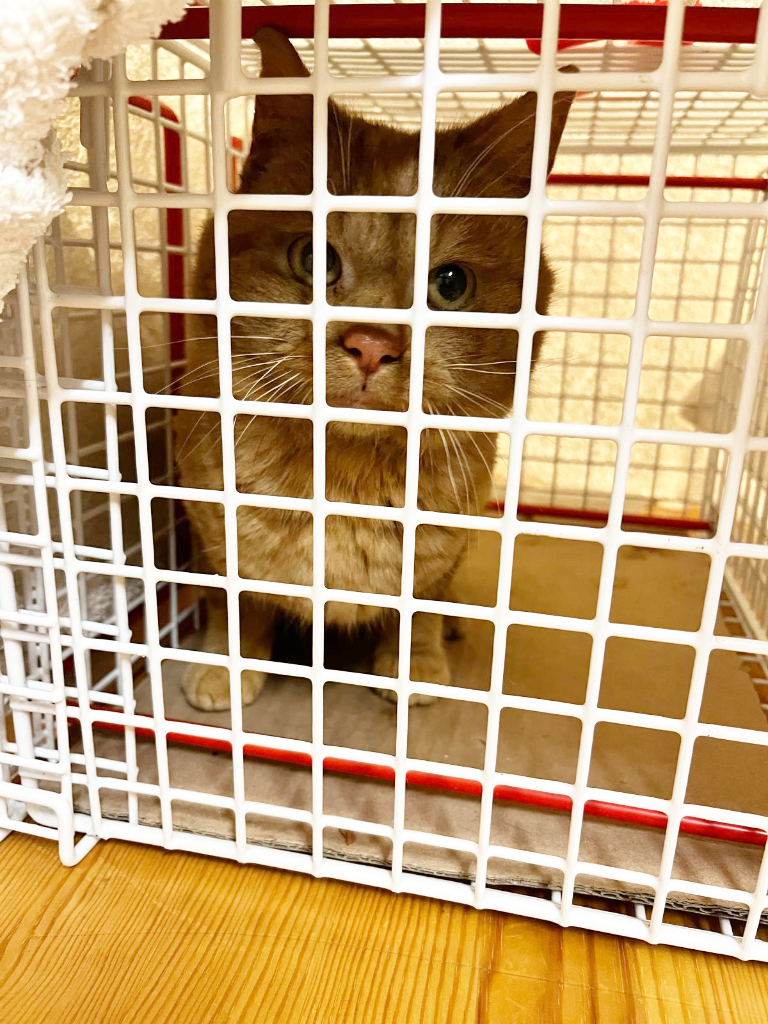
Small note about bungee clips
Trapping on my own, I couldn’t manage without bungee clips.
Once last year I had trapped a large feral cat. I was in the process of transferring him (I assume it was a he because of his size) to the transport cage.
I mentioned in the previous article about their importance.
He managed to escape though and I realised that I had made two fundamental mistakes. The ground wasn’t completely flat, so the trap and the cage were not aligned 100%. I’m not sure that that would have made a huge difference,except that when I used the bungee clips to secure the two cages together, they were not COMPLETELY taut. There was a small amount of give, and that was enough.
So I learnt a very important lesson there. My worry is that I may never manage to trap him again.
later in March 2025
I have never really enjoyed getting out of bed early. I managed to get to the feral colony last week for 7am, which for me is very good going. My ‘cut off’ point for trapping a cat is about 10.30am, so the longer that I am there, the higher the chance I have of trapping one. These lighter mornings as so welcome. Weather-wise it was a nice day too.
When I arrived, there were about six cats milling about. They soon slunk off when they saw that I wasn’t the usual person that feeds them. I got out of the car to set the trap and then settled back to wait.
As you have probably realised from the title, I did trap a cat. That was at about 8.20am, so I didn’t have to wait that long.
Nothing happened for a while. To be honest I had one eye on my book and one looking around me and at the trap.
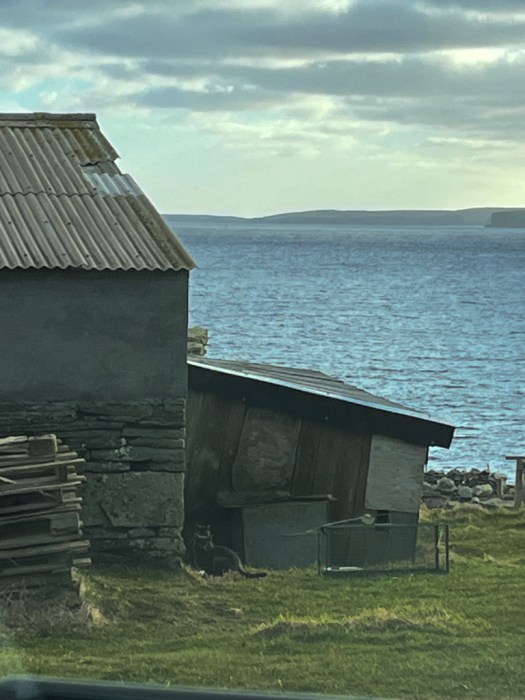
There’s not much shelter there. The cats get fed by the right side of a byre. They also have access to a small annexe on that side for shelter. If they approach the byre from the left when I’m there then they go around the back. There is a big pile of wooden pallets at the front of the byre and that offers shelter/ a hiding place too.
Now, there are two black cats that haven’t been neutered. One of them showed up and sniffed around a bit, not without casting frequent long glances over at the car. It ate the food right at the entrance of the trap and drew back. After a while it came forward again and went far enough into the trap to snatch the food that was a bit further inside.
It didn’t hang around after that.
Once it had gone, I debated whether I should put more food in the trap. I didn’t want to scare off the cats close by by going out, but if there were only food at the back of the trap, they wouldn’t be tempted. So I put food out again.
Back to waiting….
Then a smallish ginger cat appeared. This was exciting because I’d heard there was a second ginger cat about but I’d never seen him (I had trapped the other one in February).
Next a large tabby appeared then a small tabby. I’d seen these two before.
Then a large dark grey cat appeared. Now,this was the cat that I caught last year who managed to escape. I really, really hope that I manage to trap him one day.
And then a black cat was back. I think that it was the same one as earlier on. It sniffed around again and snatched the food from the entrance. So far, so good.
Then he moved into the trap. He didn’t snatch the food in the middle and dash out. He just ate the food. And then he moved towards the back of the trap. I’d put down my binoculars at this point and was putting on my gloves….
The trap door came down. He was trapped!
It wasn’t instantaneous. A split second seemed to pass before he started to thrash around in panic. I already had the transfer cage and other items sitting outside by the car door in preparation. I grabbed them and hurried over to the trap as quickly as I could.
After everything was secured I uncovered the trap and covered the transport cage in order for the cat to move over. It wouldn’t move for a few minutes, even though it must have felt very vulnerable. Sometimes they just freeze, poor things. Finally the cat moved into the covered cage and I was able to put it in the car.
The rest of the day went very smoothly. The cat turned out to be male.
I didn’t mention that whilst I was waiting I looked at all the cats’ ear tips with my binoculars. I swear that every cat I saw did not have their ear tip done. I know that seems unlikely, but that’s what it looked like.
So I’ll be back next week. I’m hoping to be there even earlier.
April 2025
I was back at the feral colony yesterday. I had prepared the car with all the equipment I needed the day before, as I planned to leave early the next morning. After a discussion with the vets we have agreed that any trapped feral cat needs to be with them earlier, so that the procedure can go ahead smoothly. So now the time for me to get there with a trapped cat is no later than 9.30am
So I was very chuffed to arrive at the colony at 6.10am. That would give me almost 3 hours. Imagine my dismay when I realised that I had left a vital piece of equipment at home: the clear perspex door that slots into the end of the trap.
So back home it was to collect that, which wasted 50 minutes of my precious time. I know that I won’t make that mistake again.
Finally everything was in place. The trap was set with a fishy, strong smelling cat food. And a while later a black cat appeared. He/she (probably a he) approached the trap warily, but then went off again without being tempted to eat anything. I was pleased because we’re pretty sure that all the black cats in the colony have been ‘done’. It would also be a shame if he did get trapped, because then I would have to release him and reset the trap. Plus, an added trauma for the hapless cat.
Now, as you know, cats have excellent eyesight. One of my colleagues was telling me that she sometimes used cardboard to obscure the windscreen when trapping, as a cat will notice the slightest movement and be scared off. She would fashion this with slits for her to see through. I have started to do this. It is tricky though because how do you know in advance that by parking in such and such a way, you can line up viewing the trap with the slits? You can’t have the car too close to the trap.
So there I was, hidden behind my cardboard. I usually have to leave the window open a bit, or else it starts to steam up and I can’t see out of the window clearly. I also needed to cough a few times. My jacket rustled as I reached for my hankie. Would they hear this?
Two cats appeared after a while. Neither of them have been fixed. The ginger boy and the small tabby. I was parked around the corner from the trap, but with the car far enough forward so I could still see the trap (and that it was still set).
Suddenly ginger boy poked his head round the corner, staring at the car for a minute or two. I turned my head slightly and then looked at him without looking at him directly. Could he have seen this movement from inside the car? It seems likely. He backed off and I didn’t see him again.
The same thing happened with the tabby, then my window of opportunity had come to an end. A thoroughly unsatisfying morning.
It’s important to write about the failures as well as the successes. I did in fact trap a male cat the week before. Many a time I have gone there and caught nothing. We are now considering not trapping there for a while because they are becoming so wary.
June 2025
Time now for an update on our progress so far.
I am still the only person who has volunteered to do the trapping and releasing (TNR) work for SCR. Which means at best I can only get one cat a week neutered.
First colony: The total neutered has now reached 5 males and 5 females, but there are still 5 more to be done. For the moment I am giving these a break, as they have become too wary of me, so harder to trap.
Second colony: All (2 males and 3 females) have now been neutered.
Third colony: I have only just become involved with this one, which has 5 cats, but have already trapped one female.
As well as these three colonies, there are many more in Shetland. SCR is working at mapping them all and making contact with their feeders (if they have one). It’s a slow process. Apart from the lack of volunteers to do the actual trapping work, before we can get started with a colony we need the cats used to being fed regularly. Only then can we make an appointment with the vet (which has to be done well in advance). On the day of trapping I then have to be free for most of the day, as it requires a very start to make sure there is enough time to trap the cat, then get it to the surgery by 9.30am. After that I am on call until the cat is ready to return to the colony.
With more volunteers we could do so much more. If you are interested in helping, by becoming a TNR volunteer, please do get in touch!
July 2025
I have an amusing tale to tell you about my last visit.
The location of the colony and where I can set up the trap, means that I can’t really hide from them. So I decided on the following strategy:
- park the car in such a way that I am surveilling the trap with my side mirror.
- place a big towel over the two headrests of the front seats, so that they don’t see my head moving.
- Have a big cotton scarf covering the windscreen so that I can still see out, but they can’t see in.
- Block my side window with a piece of cardboard, to hide my face from the side.
So I arrived there nice and early, parked up and set the trap. First of all, the towel over the headrests. Done. Then the thin cotton scarf over the windshield….
and as I was fiddling about with that, I looked up and saw one of the tabby ferals looking straight at me from in front of the car. Busted!! He stared a bit longer, then walked off.
I think all the cats showed up that morning. They may have walked past the trap, but none of them approached the food or ate any of it. I did catch something though.
The door on the trap swings out and up, when it’s in the set position. Some of food I put out is at the very entrance to the trap, and this attracts starlings too. They then get a bit bolder and wander into the trap, for the rest of the food. Meanwhile, if those on lookout, perched on the door, get to a certain number, their weight can trigger the trap door to shut.
I let it out, of course. Making a mental note to bring bird food with me next time.
later in July 2025
July has been a good month for TNR (Trap, Neuter, Release). Since my last missive we have managed to trap two more males and one female, both from the same colony.
Then this week I trapped a cat who’d already been fixed. There was still time to reset the trap though, before our appointment with the vet, and managed to catch another. Except he’d also been fixed. Very frustrating. Actually this happens quite a lot, and there’s not much we can do. Which leaves 2 cats from this colony still to trap.
As I have said before, we are limited by the lack of volunteers, so can only do TNR once a week at the moment. But still, 3 successes out of 5 appointments isn’t too bad!
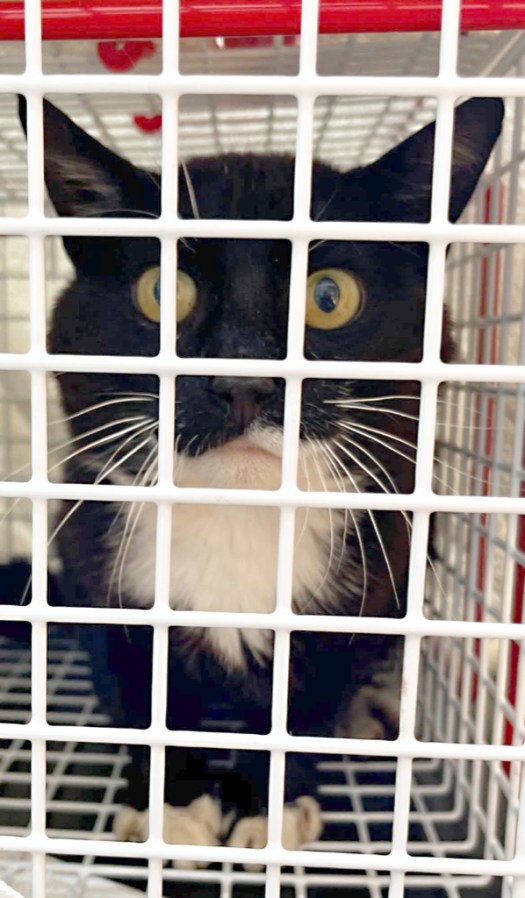
This handsome boy was one of the fixed ones we caught.
August 2025
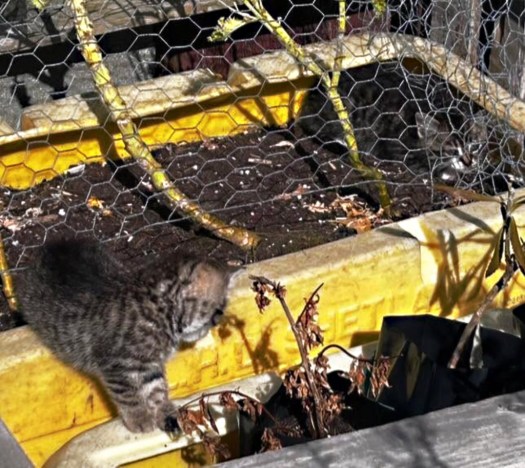
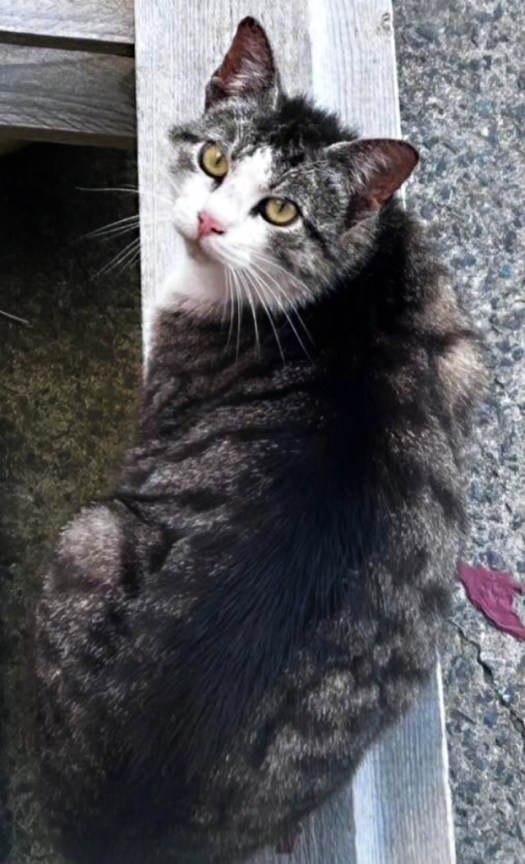
Recently we were contacted by a member of the public who had noticed a feral cat and her 3 kittens had taken up residence in her cold frame in the garden. The kittens were not yet weaned.
We hoped to trap them, so food and water were put out daily. But unfortunately we didn’t have our large trap available at the time, and the mum moved her kittens away. The owner of the house is continuing to put food out, just in case, and a neighbour has recently spotted mum nearby, so we are still hoping to trap her.
Very sadly, one of the kittens died. It was discovered near the house in a very bad way, certainly dehydrated (this was during the hot spell in July), and despite being taken to the vet didn’t make it. The two other kittens have not been seen again. We have no way of knowing if they are still alive.
So many feral kittens do not live for very long. Too many are born, only to suffer a similar fate of this poor kitten.
That is why spaying or neutering of feral cats (and domestic ones) is so important.
2025 overview
During 2025, SCR continued to expand its TNR and welfare work across several parts of Shetland.
Nesting – TNR in Nesting began in October and focused primarily on feral mothers and kittens. Two adult female tabby cats were humanely trapped, neutered and released, including one female caught with her third litter. Six kittens from several litters were safely trapped over the month and placed in foster care, helping to prevent further breeding while ensuring vulnerable cats received appropriate care.
Sandwick – Activity took place throughout 2025 and included several adult cats. This involved a ginger male with an injured paw in February, two black males neutered and released in March and April (one with a small white chest patch), a black cat fostered due to illness in October, a dark brown/ black ticked tabby released after confirmation of prior neutering, and one adult humanely euthanised in November due to oral tumours.
Bressay – Bressay experienced a very busy and varied period of trapping. Over the season, several cats were humanely trapped, neutered and released, including multiple black and black-and-white adults and a tabby female. One black female required significant veterinary intervention, undergoing amputation of a deformed back paw before being spayed, fostered and successfully returned to her territory. A number of kittens were also rescued, with several litters taken into foster care, one kitten later adopted, and one sadly passing away despite care. In addition, an adolescent male tabby was neutered and released, and one adult male was believed to be owned and was returned after assessment. Overall, the work on Bressay reflects a combination of TNR, emergency welfare intervention and kitten rescue, with positive outcomes for the majority of cats involved.
Other areas – Elsewhere across Shetland SCR responded to several individual cases. On 6 September, a semi-feral black kitten was trapped and fostered in Bigton, and on 15 September a tabby kitten found in Whiteness was also placed with a fosterer. A feral kitten found in Brae on 30 August was taken into care. In Lerwick, a sick cat named Leo was rescue on 21 May and taken to the vet but sadly had to be euthanised due to sever kidney failure.
Another busy and productive year, with cats helped across multiple parts of Shetland and several kittens safely trapped and fostered. Our ongoing TNR work continues to prevent more litters of kittens while improving the health and welfare of adult cats living outdoors.
We remain deeply grateful to our volunteers, members of the public and veterinary partners whose support makes this work possible. Every cat trapped, treated, and returned represents a small but meaningful step towards a healthier, more stable cat population across Shetland.
…. to be continued.
*
Pauline Dean’s experience of trapping in rural Spain
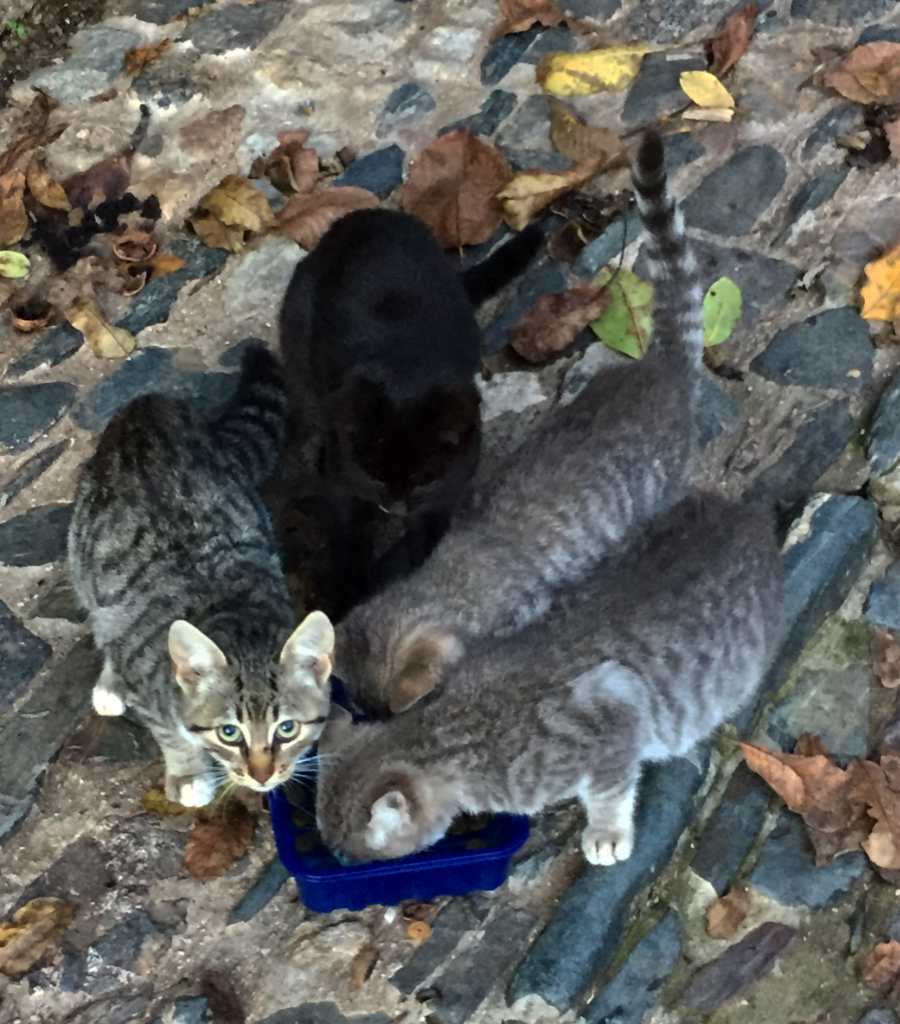
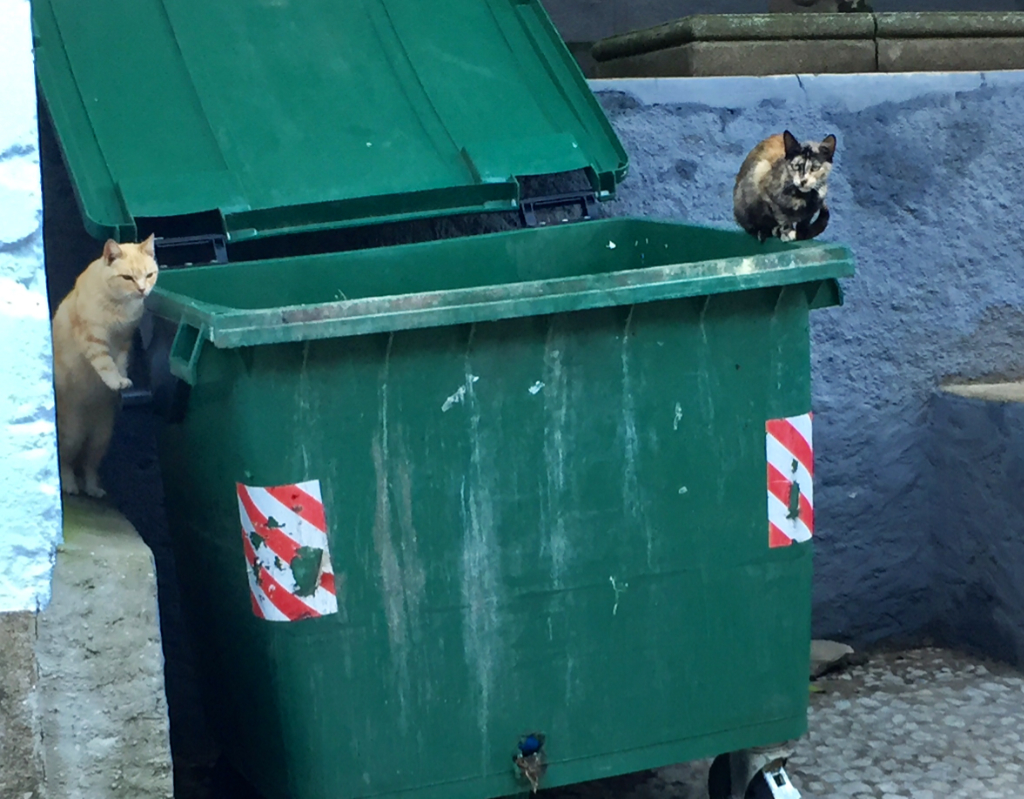
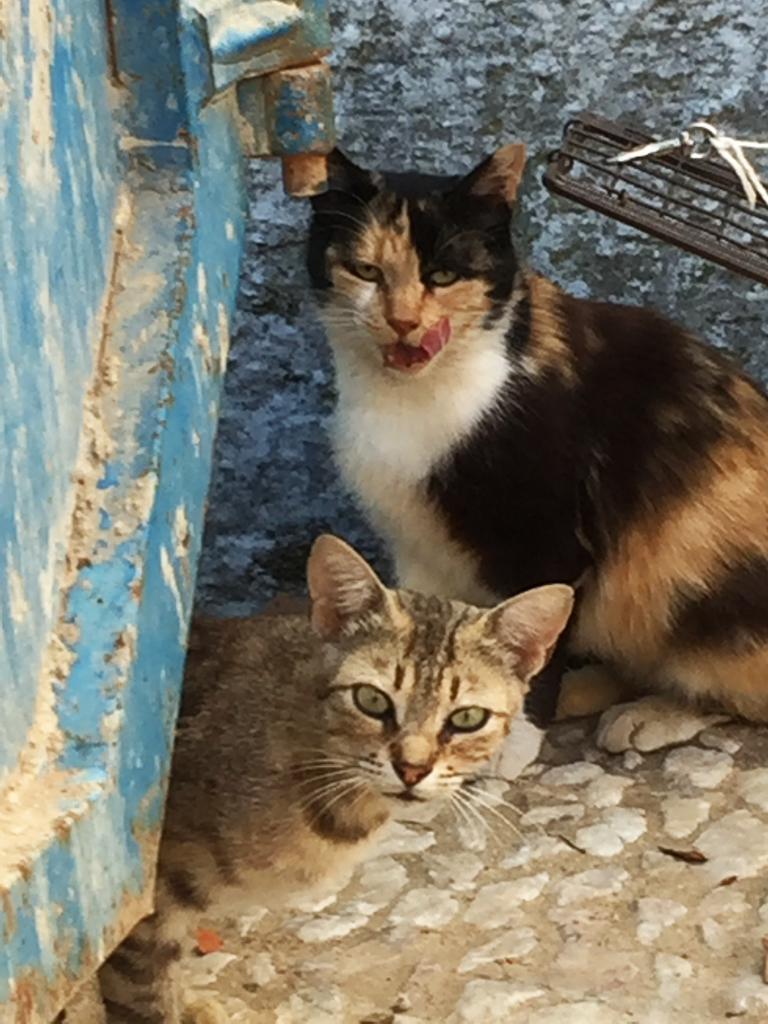
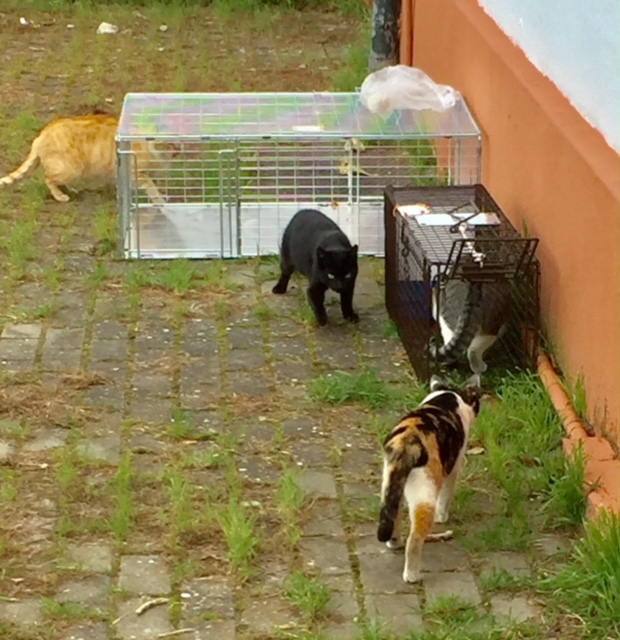
swipe for more photos
Before returning to Shetland (and becoming one of the trustees at Shetland Cat Rescue) I spent some time living in the small Andalucian town of Almonaster la Real, where there were a lot of street cats, also known as community cats. They lived in several colonies, many having feeders who paid for the food themselves. They were doing this unobtrusively, because some of the population did not approve of helping cats. There was no TNR nor any group that could help. When there were complaints about the cats, the local council would send a van round to trap as many as they could. These cats were never seen again.
Over time I began to recognise some of cats in each particular street, many of whom were female and frequently pregnant, but rarely saw any of their kittens. One colony, with about 6 females, had only 3 surviving kittens by the autumn of that year. When I spoke to people about this they didn’t seem to think it was a problem. Kittens die, they said, and if they made it to adulthood they didn’t live long either. One of the reasons, apart from disease and injuries from fighting, was many would be run over. The roads in town were not busy, and the narrow streets making driving very slow, but the cats still got run over.
My partner and I talked to some Spanish friends and together we decided to do something about this. With the help of Rocio, a cat lover who also speaks excellent English, we set up Animales Protegidos en Almonaster la Real, APA for short. A small band who wanted to do something positive for the street cats. Rocio steered the group through all the paperwork to enable APA to become an official non-profit organisation, like a charity. Our first fundraiser was a stall at the town’s Xmas market. It was not a big affair, there were only two other stalls, but we made our first €200. SNIP International donated a trap and three transfer restrainer baskets. TNR could now begin.
At that time the vets in the area mainly dealt with pigs (destined to become Chorizo.) Few people would think of taking a dog or cat to a vet when it needed help, so consequently vets were not very familiar with the care of small animals, although things are changing now. We were very lucky to find Francisco, a vet in nearby Aracena, who not only knew something about cats, but wanted to help us. He also spoke English, as he had worked in an abattoir in the very town I was born in! I am not good at languages. I had learnt some of the basics, like “Good morning, how are you?” “Is your cat castrated?” “Why is your cat not castrated?” Everyday phrases. Francisco gave us a very favourable price for neutering and spaying and joined APA’s committee.
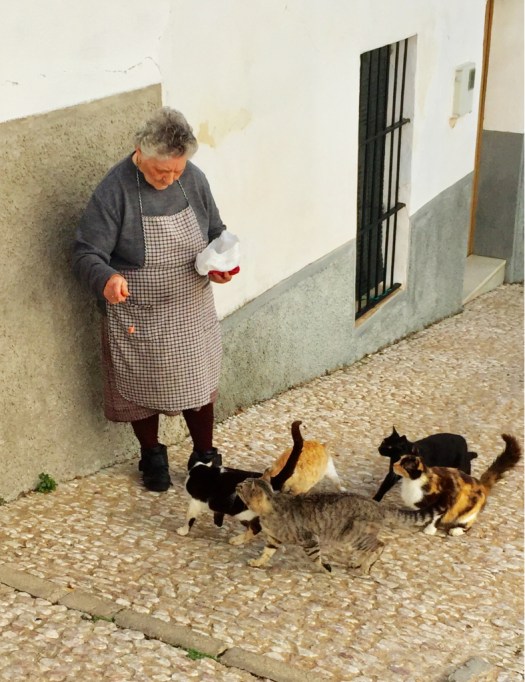
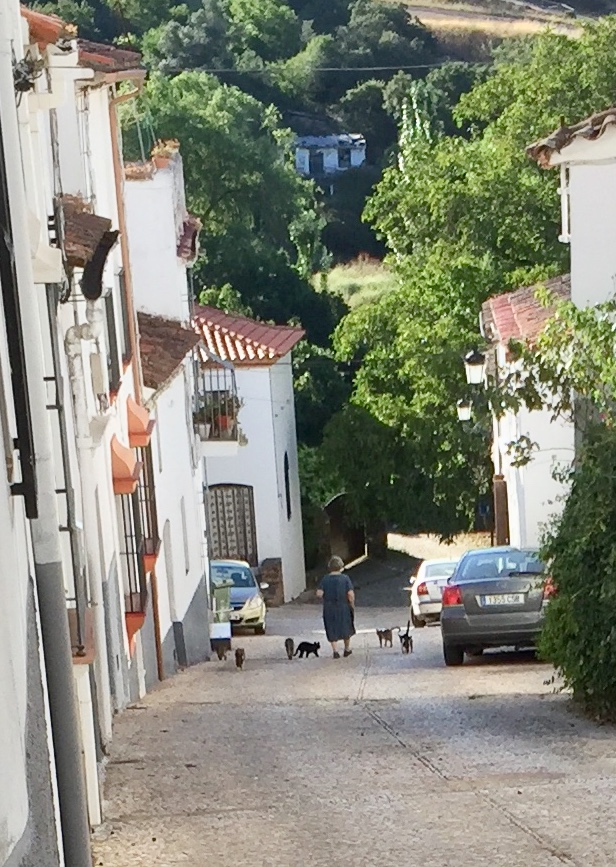
We decided to start the TNR with a colony where there had been a lot of complaints to the council. The family of the feeder had also contacted us as they were concerned that she was spending all her money on the best food for the cats, leaving little for herself. The cats would be waiting outside her house first thing every morning. I shall never forget seeing her walking down the street followed by her feline retinue. Little did I realise that it would soon be me who would be doing exactly that, in order to get to know them all and gain their trust. I started going early each morning, armed with my bag of biscuits. It was fascinating watching the colony change from just a pile of unrecognisable tabby cats, with a few black & whites and the odd tortie or two, to seeing them all as individuals. There was One Eye, an older matriarch who had the respect of all the others. She had a kitten that she was looking after, the only one of hers to survive that year. She was one of the first to be spayed and ear tipped. No more pregnancies and trying to raise kittens for her!
One pretty long-haired tortie & white was very friendly, far more than any of the other street cats. She was also about to burst with a very pregnant belly. I had to go away for a couple of weeks at that time and was amazed to see that she was still pregnant on my return. Then, within a few days, she had deflated, yet I never saw any of her kittens. After a week I also noticed she no longer had any milk either and was always on the street. I asked around where the cats went to have their kittens, but no one seemed to know. It was obvious hers had not survived. Was it just too hot in the Spanish summer? Had she no milk? Did she get enough to drink and eat? Was it a predator? People blamed the owls, saying they took kittens, but I think this highly unlikely.
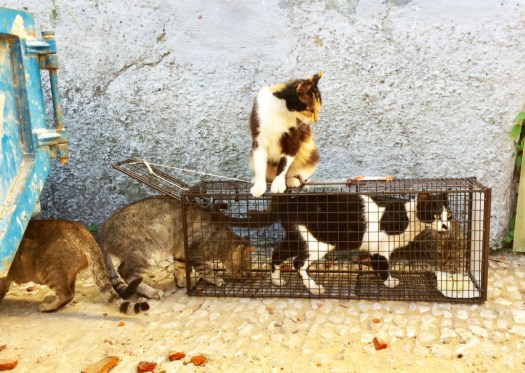
Getting cats into the trap was not a problem. I always fed them in an unset trap for a few days before neutering day. They would be queueing to get the food before I arrived and happily walk straight into the trap. The tortie & white was so friendly she didn’t even need trapping, I simply picked her up and placed her in the basket.
After neutering I would take them to the end of the street where they lived, still in the baskets, and wait with them. It was quiet and peaceful, well away from traffic and with plenty of shade. Trying to explain what I was doing to any passers-by, in my limited Spanish, was not easy, but I could manage “Trap, Neuter and Return” in Spanish, though some obviously thought that I neutered them myself in the back of the van.
Tortie & White was so pretty and friendly she always got more than her fair share of the food because she had no fear of people. She was also very hungry when she was pregnant. Then one day she disappeared and I never saw her again. Later, I found out she had been reunited with her owner, who lived 40 miles away. Apparently she had arrived after hiding away in a car, scared by the fireworks at a local fiesta. The car drove off, stopping when it reached Almonaster and she escaped.
As we got more successful Rocio put in an application to the council for funding, which unfortunately was not accepted, so we applied to them to hold a regular fundraising stall in the square instead. Every Saturday we sold crafts and second hand goods. This was something quite new to the area, but eventually people got used to the idea and started giving us donations, until we were able to open a shop, which was also a first for the area. Running a second hand shop when you speak very limited Spanish, was quite a challenge. I learnt my numbers first, in order to tell people the prices, even though I had made price tags for everything. I finally managed to get my tongue round the tongue twister “cincuenta centimos” (which means 50 cents), and was something I seemed to struggle with.
I was keen that every hard earned euro was spent directly on helping the cats and this we managed. 47 cats were neutered over 15 months, which included 18 from the colony I first started with. Every cat in that colony, except the one that got away. I regret that I foolishly let him escape when I was transferring him from the trap to the basket. He did not show up for many weeks after that and only started to come for food again a few days before we were due to leave permanently (to return to Shetland). I had so much to do then I just could not afford a whole day to take him to the vets. The ones I was most pleased with were the five youngsters, who were about five months old. At least they will not have to go through pregnancies and watch their kittens die.
When we left Spain, we took with us our four Spanish cats, each of whom had turned up at the door. I am really pleased to say that APA still continues to grow, and now a new law has been passed in Spain which means that TNR is the method councils must use to control street cat populations. You can find out more about APA on their Facebook pages, one in English and the other in Spanish.
*
Shetland Cat Rescue could help a lot more cats and colonies, especially now winter is upon us, if we had more volunteers. If you feel you would like to get involved, especially on the other islands, please get in touch. You will be made very welcome joining the team at Shetland Cat Rescue!
 shetlandcatrescue.co.uk